Ciao! I’m Giulia. Last week we served cabbage at snack time, played dumb, and timed our cheese perfectly (read the first 3 idioms here if you missed them). You asked for more — so here’s the second helping: three food idioms about revenge, bluffing, and the mysterious shrinking arm that appears every time the bill arrives. Bis!
1. Rendere pan per focaccia — “To return bread for focaccia”
Literal picture: someone gives you plain bread (pane), and you hand back fragrant, oily focaccia. A fair exchange? Not quite — focaccia is clearly the upgrade. That’s the whole joke: the payback is slightly bigger than what you received.
Real meaning: tit for tat — repaying someone in kind, usually a small, satisfying revenge.
How to use it:
- “Mi ha rubato l’idea alla riunione, ma alla fine ho preso io il progetto. Pan per focaccia!” (He stole my idea at the meeting, but in the end I got the project. Tit for tat!)
- “Mi ha fatto aspettare un’ora? La prossima volta aspetto io lei. Pan per focaccia.” (She kept me waiting an hour? Next time she waits for me. Tit for tat.)
Register note: mischievous but good-natured. It admits the revenge openly and with a smile — very Italian. Works with friends, family, and colleagues, as long as everyone laughs.
2. Non è farina del tuo sacco — “That’s not flour from your sack”
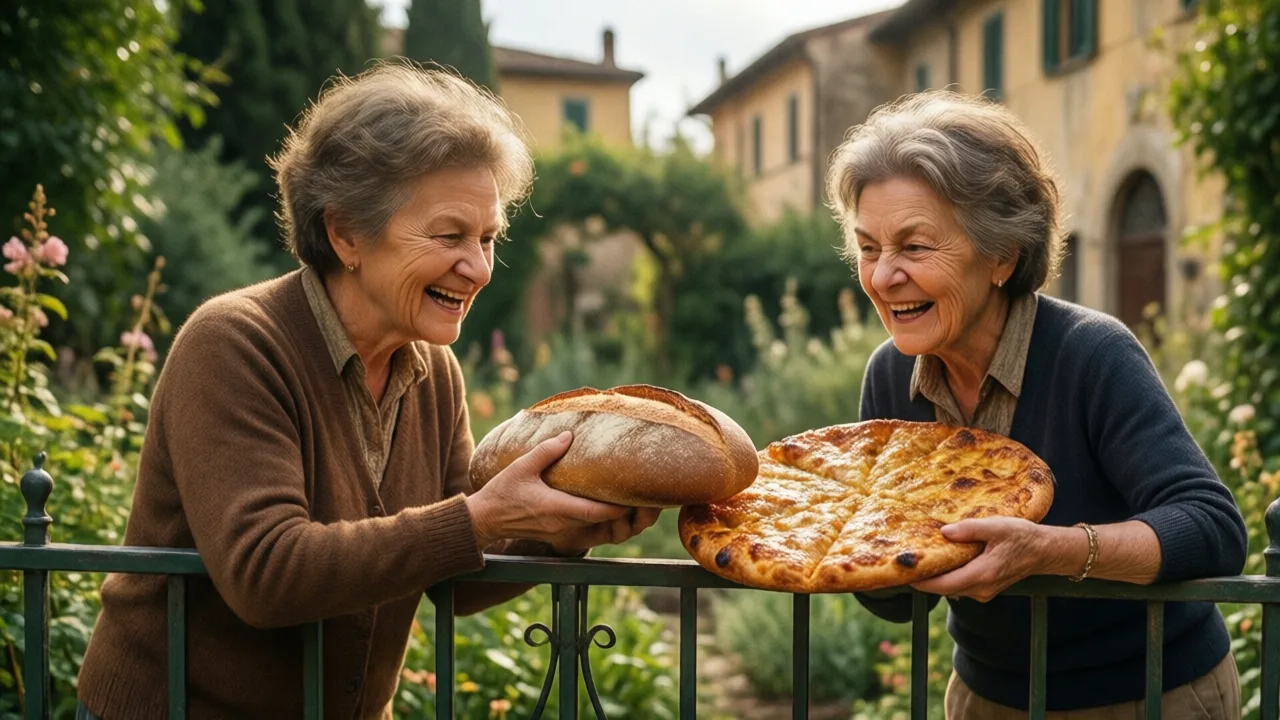
Literal picture: every baker works from their own sack of flour (sacco). If the bread is suspiciously perfect and your sack is still sealed, the flour — and the merit — came from somewhere else.
Real meaning: you didn’t come up with that yourself. The classic unmasking of bluffing, copying, or borrowed brilliance.
How to use it:
- “Bel discorso, Marco. Ma non è farina del tuo sacco, vero?” (Nice speech, Marco. But that’s not really yours, is it?)
- “Il tema era perfetto… troppo perfetto. Non era farina del suo sacco.” (The essay was perfect… too perfect. It wasn’t really his work.)
Teachers deploy this with surgical precision. Bosses too. It’s a polite accusation wrapped in a bakery metaphor — devastating and delicious.
Register note: ironic and pointed. Among friends it’s banter (“wow, such poetry — definitely not your flour!”). From a teacher or boss, it’s a warning shot.

3. Avere il braccino corto — “To have a tiny short arm”
Literal picture: the restaurant bill (il conto) lands on the table. Everyone reaches for their wallet — except one person, whose arm is suddenly, tragically, a few centimeters too short. The diminutive -ino (little arm, braccino) makes it sound cute. It is not cute. It happens every single dinner.
Real meaning: to be stingy — mysteriously unable to pay your share.
How to use it:
- “Quando arriva il conto, Luca ha sempre il braccino corto.” (When the bill comes, Luca’s arm is always too short.)
- “Non fare il braccino corto, tocca a te offrire!” (Don’t be stingy, it’s your round!)
The beauty of this idiom: it describes a temporary medical condition that strikes only at payment time and cures itself the moment someone else pays.
Register note: the standard friendly accusation among Italian friends. Everyone knows a braccino corto — and everyone denies being one.

Quick recap: tonight’s menu
| Idiom | Means | Serve when |
|---|---|---|
| Rendere pan per focaccia | Tit for tat | Someone owes you one |
| Non è farina del tuo sacco | Not really yours | Someone is bluffing |
| Avere il braccino corto | Stingy | The bill arrives |
This week’s challenge: catch one braccino corto in the wild and deploy the idiom on the spot. (Then pay your own share immediately, or the irony will destroy you.)
Missed the first course? Start with 3 Funny Italian Idioms That Make No Sense, then continue to my 10 proverbs I actually use. And if you want to understand Italians before they finish the sentence, my free 10-lesson crash course is the fastest starter — or message me on WhatsApp and we’ll practice over coffee. Il conto lo offro io. Forse.