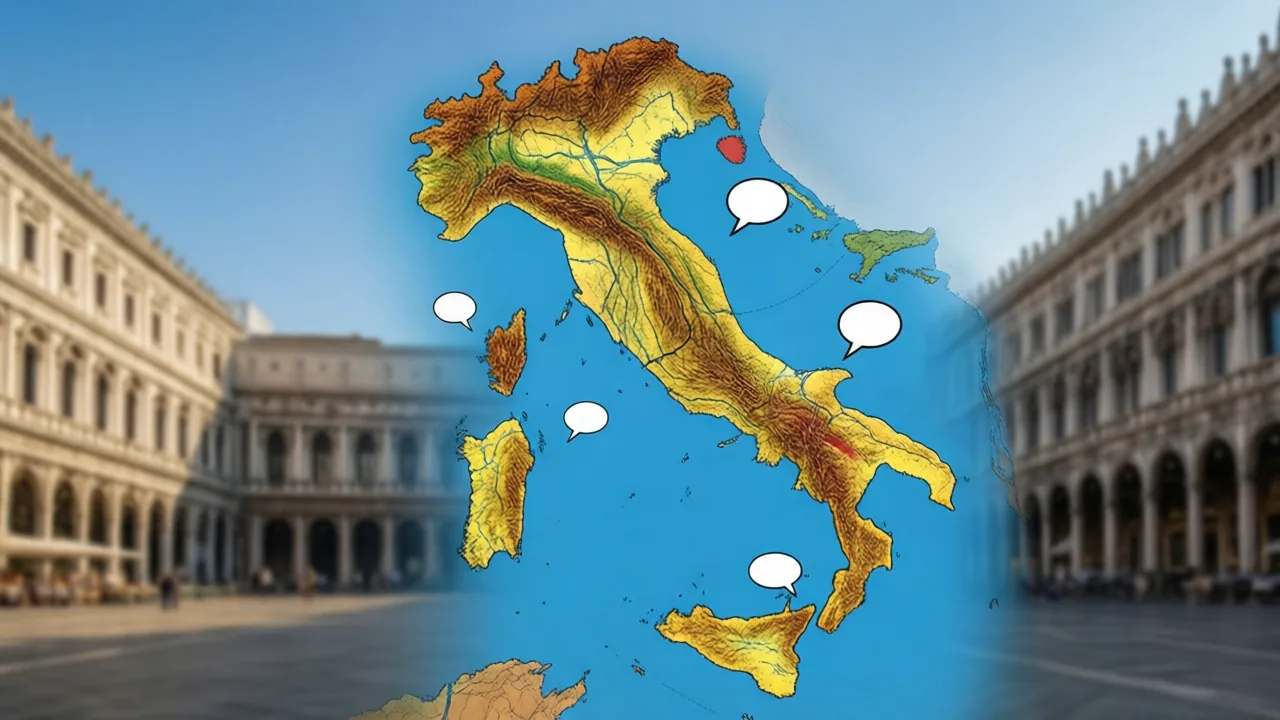
Italian accents vary dramatically by region (the crisp north, the melodic south, the rolled Tuscan), but standard Italian is understood everywhere. For a learner, the question is simple: learn the neutral standard first, then get used to the regional colours you’ll actually hear.
Here is how the accents differ, and why it matters for your learning.
The Big Picture: Standard vs Regional
Italy’s regions each have their own accent and, in many cases, their own local dialect:
- Standard Italian: the language of schools, TV, and official life, modelled on the Tuscan/Roman tradition. Understood by everyone.
- Regional accents: how each area pronounces and “sings” that standard: different vowels, intonation, speed, and local words.
- Regional dialects (dialetti): separate local languages (Neapolitan, Sicilian, Milanese, Venetian…), not “wrong Italian”.
Your goal is standard Italian. Your listening goal is to survive the accents.
The Main Accent Regions
| Region | What it sounds like |
|---|---|
| North (Milan, Turin, Veneto) | Crisper, faster, influenced by Lombard/Venetian: some vowels shorten, hard z sounds |
| Centre (Tuscany, Rome) | The Tuscan gorgia, the soft “h” sound between vowels (la casa → la hasa); Roman variety is very common on TV |
| South (Naples, Calabria, Sicily) | More open vowels, a strong melody, schwa-like unstressed vowels, and dialect vocabulary |
| Islands (Sicily, Sardinia) | Distinct musicality and influences from Arabic, Spanish, and Greek in the local dialects |
The Tuscany Surprise: The ‘H’ Sound
Tuscany does something famous to standard Italian: it turns hard consonants between vowels into a breathy “h” sound.
- La casa → la hasa;
- Le porte → le horte.
You will hear this in Florence and Siena. It is a regional feature, not an error, and it is exactly the kind of thing that confuses learners who studied “textbook” Italian.
Why It Matters for Learners
- Listening is a skill. Real Italians speak faster and with more colour than teaching audio. Expose yourself to real accents early.
- Don’t imitate one region. Learn neutral standard pronunciation; it works everywhere. This is what I teach in my pronunciation guide for English speakers.
- Know the difference between accent and dialect. If someone in Naples sounds “different”, they are using a local accent/dialect, not wrong Italian. My Italian dialects guide covers the language side in depth.
- When you travel or relocate, learn the local colour: a few words of the local accent will delight locals.
The Practical Learner Strategy
- Learn standard: neutral pronunciation, the variety on TV and radio;
- Listen to real content from across Italy: podcasts and shows by level expose you to natural speed and accents;
- If you move somewhere (say, to Naples or Milan), spend the first weeks tuning your ear to that region’s accent;
- Never stress about dialects: you do not need them.
Frequently Asked Questions
Do Italian accents differ by region?
Yes, noticeably: in vowels, intonation, speed, and local words, on top of the shared standard language.
Is standard Italian the same everywhere?
Understood everywhere. Schools, TV, and official life use the neutral standard; accents and local words vary.
Which accent should I learn?
The neutral standard (used on television and in schools), understood by everyone. Add regional awareness later.
Why do northern and southern accents sound different?
Northern accents show Milanese/Lombard influence (crisper, faster); southern accents have more open vowels and a distinctive melody.
Should learners worry about regional dialects?
No, focus on standard Italian. A little regional awareness helps when travelling, but dialects are separate local languages.
Want Italian that’s understood in every region?
My free 10-lesson Italian crash course teaches neutral, natural Italian with clear pronunciation, no sign-up and no pressure. For live practice, message me on WhatsApp.
Start the free crash course or chat with me on WhatsApp.
Buon viaggio on your language learning journey! 🇮🇹