Ciao! As an Italian native and language teacher, one of the things that fascinates newcomers to Italy (and even Italians themselves!) is the incredible variety of local dialects. You travel just 50 kilometers, and sometimes the way people speak changes quite dramatically. It’s something I grew up with, and it’s a huge part of what makes Italy, well, Italy.
Often, people think of these as just funny accents or maybe slightly different versions of standard Italian. But honestly, it’s much deeper than that. Many Italian dialects are so different from standard Italian that they could almost be considered separate languages, with their own grammar, vocabulary, and history.
So, forget the idea of just one “Italian language” spoken uniformly from the Alps to Sicily. Let’s take a little tour together, and I’ll show you some of the amazing linguistic diversity you can find across the country. It’s not just about different pronunciations; it’s about entirely different ways of expressing things, rooted deep in local history and culture. This isn’t just a linguistic curiosity; understanding this diversity gives you a much richer picture of Italy.
First Things First: What Exactly is an Italian Dialect?
Before we jump in, let’s clear something up. When we talk about dialetti italiani (Italian dialects), we’re usually not talking about regional accents when speaking standard Italian. For example, someone from Milan speaking standard Italian will sound different from someone from Naples speaking standard Italian – that’s an accent, or what we call Italiano regionale (Regional Italian).
Dialects, on the other hand, often predate standard Italian itself! Italy as a unified country is relatively young (unified in 1861). Before that, the peninsula was a patchwork of states, kingdoms, and republics, each with its own local vernacular languages derived from Latin, often with influences from other languages due to invasions or trade (Greek, Arabic, French, Spanish, German…).
Standard Italian is largely based on the Florentine dialect of the 14th century, thanks to writers like Dante, Petrarch, and Boccaccio. It was adopted as the national language, but the local dialects continued (and continue) to be spoken alongside it, especially in informal settings, at home, and among older generations. Some dialects, like Sardinian (Sardo) or Friulian (Furlan), are even officially recognized as distinct minority languages.
So, think of dialects as sister languages to standard Italian, which evolved in parallel from Latin, rather than just variations of Italian. This is why someone from Veneto might genuinely struggle to understand someone speaking deep Sicilian dialect, and vice versa.
Now, let’s explore some of the main dialect groups you might encounter.
Heading North: Efficiency and Elegance
The North of Italy has historically been influenced by Celtic and Germanic languages, which you can sometimes hear subtly reflected in the sounds and vocabulary of its dialects.
Lombard Dialect (Lombardia)
Think of Milan, the bustling heart of Lombardy. The traditional Milanese dialect (Milanès) often sounds quite clipped and efficient, maybe reflecting the business-like nature of the city. Vowels can be different from standard Italian, sometimes shorter or closer to French or German sounds (like the ‘ü’).
A classic example people often mention is the word for ’nothing’ or ’no’. In standard Italian it’s niente or no. In Milanese, you might hear nagòtt. Or the word for ‘child/boy’ - ragazzo in Italian, becomes fiöö or tòs.
The original text mentioned Milanese debating fashion: “Quel vestito è una vera strunzata! Sembra un telo da stendere!” (That dress is utter garbage! It looks like a bedsheet!). While funny, this is standard Italian with a strong opinion. A more dialectal flavour might be something simpler, perhaps focusing on a typical Milanese interjection like “Uè, ma che schifezza l’è quèll vestii?” (Hey, what kind of awful thing is that dress?). The tone is often direct, less musical than southern dialects. You also hear lots of useful everyday words like schiscetta (packed lunch) that have entered regional Italian.
Venetian Dialect (Veneto)
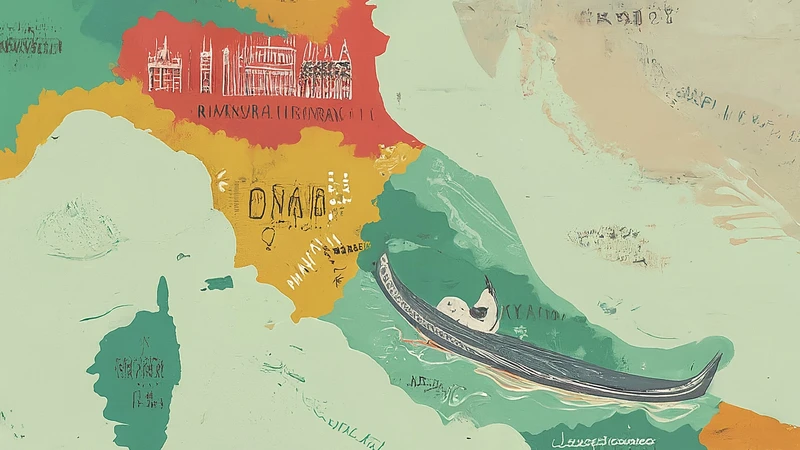
Moving east to the Veneto region, the Venetian dialect (Vèneto) has a very different feel. Historically, Venice was a powerful maritime republic, and its language was used across the Mediterranean. It often sounds softer, more flowing than Lombard.
One famous feature is the tendency for ’l’ sounds between vowels to disappear or become very soft, almost like an ’e’ sound – so bello (beautiful) might sound more like beo. The ’s’ sound can also be softer, almost like an English ’th’ in some variations (z instead of s or c).
The example given was: “Bona sera, tesoro! Che ghe xe de belo che te po’ far?” (Good evening, my treasure! What beautiful things can I do for you?). This captures some flavour. “Ghe xe” (there is/are) instead of c’è / ci sono is classic Venetian. Another typical word is schei for money (soldi in Italian) or goto for a glass (of wine, usually - bicchiere in Italian). Hearing someone order “un goto de vin” is quintessentially Venetian. It has a certain elegance, I think, a reminder of its grand past.
Central Italy: The Cradle of Standard Italian and Roman Wit
Central Italy is linguistically dominated by Tuscany, the birthplace of standard Italian, but also features the unique character of Rome.
Tuscan Dialect (Toscana)
As I mentioned, standard Italian is based on Florentine Tuscan. So, you might think speaking Tuscan is just speaking perfect Italian. Well, yes and no. While vocabulary and grammar are very close, the pronunciation is distinct.
The most famous feature is the Gorgia Toscana (Tuscan Throat), where ‘c’ sounds between vowels become aspirated, almost like an English ‘h’. So, la casa (the house) sounds like la hasa, and dico (I say) sounds like diho. This can be quite striking when you first hear it!
Tuscans are often proud of their ‘pure’ Italian, sometimes humorously looking down on other regional accents or dialects. The example “Mi porti una pizza margherita, per favore… e sì, ti amo!” (Please bring me a margherita pizza… and yes, I love you!) is more about Tuscan charm than dialect. A better example of Tuscan speech might be hearing someone say “Andiamo a mangià’ una bistecca alla fiorentina, ma’he bona!” (Let’s go eat a Florentine steak, how good it is!), noticing that aspirate ‘c’ in ma’he (ma che). It’s clear, often considered quite elegant, but definitely has its own regional sound.
Romanesco (Lazio)
Ah, Romanesco, the dialect of Rome! This is one many people recognize, partly thanks to Italian cinema (think Alberto Sordi). It’s known for being very direct, often humorous, and full of colorful expressions.
Grammatically, one common feature is shortening words, especially articles and prepositions: ‘sto for questo (this), ‘sta for questa, ’n for un, aò as a general exclamation or greeting. Verbs might get shortened too, like annà for andare (to go). There’s also a tendency to use ’l’ instead of ‘r’ before consonants in some cases (though this is becoming less common).
The example “Ma che stai a dì? Che ‘sti? Che cos’è sta roba?!” (What are you saying? What is this? What is this thing?!) definitely captures the dramatic, slightly exasperated tone common in Romanesco. You might hear someone stuck in traffic yell “Aò, ma che stai a fa’? Daje!” (Hey! What are you doing? Come on! / Hurry up!). Daje is a classic Romanesco word, meaning ‘come on’, ’let’s go’, or expressing encouragement. It’s expressive, loud, and has a certain rough charm.
Southern Italy: Music, Passion, and Ancient Roots
The South of Italy is where dialectal diversity really explodes. Influences from Greek, Arabic, Norman French, and Spanish have created dialects that sound incredibly different from standard Italian and from each other.
Neapolitan Dialect (Campania)
Napoletano, the dialect of Naples, is perhaps one of the most famous Italian dialects, known worldwide through songs like ‘O Sole Mio. It’s incredibly rich, musical, and expressive.
Phonetically, one key feature is the schwa sound (like the ‘a’ in ‘about’ in English), often represented as an ’e’ or omitted in writing, which appears at the end of many words where standard Italian has a clear vowel. For example, Napoli becomes Napule. Vowels within words can also change: o often becomes u, and e often becomes i. So sole (sun) is sule, nero (black) is nire.
The example “Voglio na pizza margherita, ma con duplice mozzarella e nu’ pocu ’e peperoncino!” (I want a margherita pizza, but with double mozzarella and a bit of chili pepper!) shows some Neapolitan words like na (a/one, feminine), nu’ pocu ’e (a bit of). Another classic is “Ué, guagliò!” (Hey, kid/guy!), a common informal greeting. The rhythm and intonation are just as important as the words themselves; it truly sounds like music sometimes. It’s fast, lively, and full of emotion.
Sicilian Dialect (Sicilia)
Finally, we reach Sicily, an island with a complex history reflected in its language. Sicilian (Sicilianu) is often considered a language in its own right, not just a dialect of Italian. It has significant Greek, Arabic, Norman, and Spanish influences that make it distinct.
Pronunciation differs greatly from standard Italian. For instance, Latin ’ll’ often becomes a sound like ‘dd’ (sometimes written ‘ḍḍ’), so bello (beautiful) becomes beddu. The Italian group ‘gli’ often becomes ‘gghi’, so figlio (son) is figghiu. The Italian ‘str’ cluster often becomes ‘str’ with a retroflex ‘r’ sound, or sometimes simplifies. Vowels can also differ significantly.
The example “Turna a sinistra a quell’incrocio, poi devi continuare dritto fino a quando trovi ’na fontana… ma attenzione, si ’nnaffuocati!” (Turn left at that intersection, then keep going straight until you find a fountain… but be careful, it’s on fire!) is quite dramatic! A simpler, common example might be asking “Chi sì?” (Who are you? - Chi sei? in Italian) or using the word picciriddu for a small child (bambino in Italian). Sicilian often sounds strong, expressive, and is famously accompanied by a lot of hand gestures, which are an essential part of communication across much of Southern Italy.
What About All the Others? And What Does This Mean for Learners?
I’ve only scratched the surface here! There are countless other dialects:
- Piedmontese in the northwest, with French influences.
- Ligurian (Genoese), another important maritime language.
- Emilian-Romagnol, a group of dialects in the central north.
- Sardinian, actually a separate Romance language with several varieties.
- Friulian, another recognized minority language in the northeast.
- Dialects of Puglia (Pugliese), Calabria (Calabrese), Basilicata (Lucano)… each unique.
The reality today is complex. While standard Italian is understood and spoken by virtually everyone thanks to school and national media, dialects are still alive, especially in informal contexts, among family, and in smaller towns or rural areas. In some regions, they are used more proudly and openly than in others. Sadly, many are less spoken by younger generations and are considered endangered.
So, what should you, as a learner of Italian, do about dialects?
My advice is always to focus on learning standard Italian first. This is the language of education, media, business, and literature, and it will allow you to communicate anywhere in Italy. If you’re starting from zero, start with a real A1 course — and once you can handle everyday conversations, our A2 Elementary guide shows you how to turn passive understanding into real conversation. Trying to learn a specific dialect from the beginning is usually not practical unless you plan to live long-term in a specific region and integrate deeply into the local community.
However, being aware of dialects is incredibly useful:
- Understanding: You’ll realise why sometimes you don’t understand Italians speaking amongst themselves, even if your standard Italian is good. It might be dialect!
- Appreciation: Knowing about dialects deepens your understanding of Italian culture, history, and regional identities. It shows respect for local traditions.
- Travel: When you travel, you’ll hear dialect words sprinkled into everyday conversation (regional Italian). Recognizing a few local terms can be fun and endearing.
- Richness: It adds another layer to the richness of Italy. It’s not a monolithic country, and the languages reflect that beautifully.
Don’t be intimidated by dialects. See them as part of the colourful fabric of Italy. Listen out for them when you visit or talk to natives from different regions. Ask people about their local dialect – most Italians enjoy sharing this part of their heritage.
Wrapping Up Our Linguistic Tour
From the fast-paced talk of Milan to the melodic flow of Venice, the clear sounds of Florence to the sharp wit of Rome, and the passionate rhythms of Naples and Sicily – Italy’s dialects are a fascinating world. They carry centuries of history, culture, and local identity.
While your goal should be mastering standard Italian, I hope this little tour helps you appreciate the amazing linguistic diversity you’ll find here. It’s not a “rollercoaster” or just a “comedy show” – it’s a living testament to Italy’s rich past and vibrant present. Embrace the variety, listen closely, and enjoy discovering the many voices of Italy!
Buono studio e buon viaggio nel mondo dei dialetti! (Good studying and enjoy your journey into the world of dialects!)
Want to understand Italians wherever you travel — North to South? Start with a real A1 course or book a free intro lesson to get a personal plan.