📖 New! Visit the Italian A1 Beginner Level Guide – a complete hub for beginner resources including noun gender, basic vocabulary, and essential grammar rules. Bookmark it for your foundational Italian journey.
La Mano Plural in Italian: Making Sense of Irregular Plural Forms
If you are learning Italian, you’ve probably noticed that the language loves its rules, and it loves breaking them even more. One of the most common stumbling blocks for beginners is figuring out the “la mano” plural in Italian.
Why is a word ending in “-o” feminine? And why does it change to “-i” in the plural?
Don’t worry! You aren’t the only one scratching your head. Let’s break down exactly how to pluralize la mano, along with a few other quirky irregular plurals you’ll use in everyday Italian conversation.
The Quick Answer: What is the plural of “la mano”?
Let’s get straight to the point:
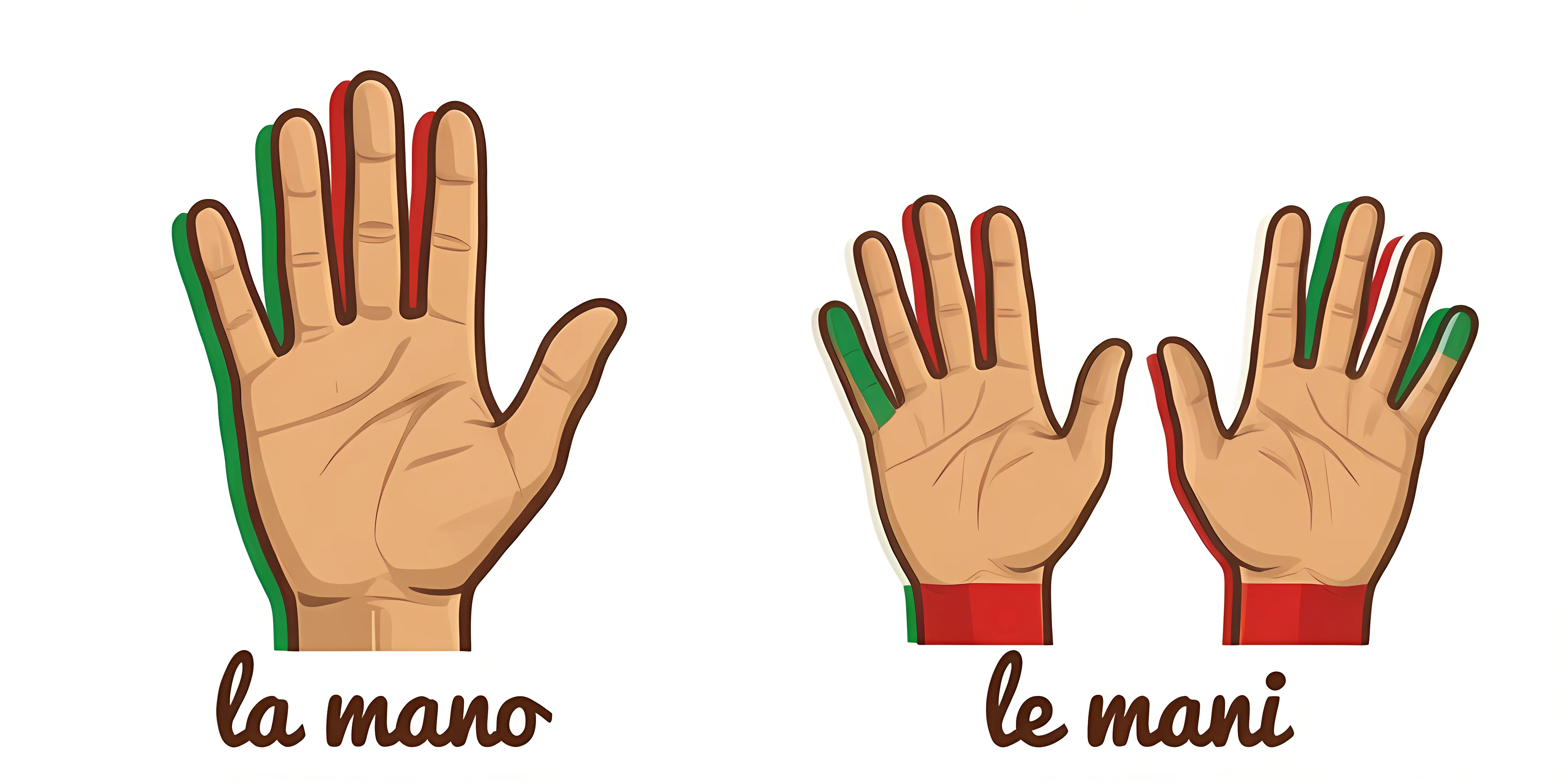
- Singular: la mano (the hand)
- Plural: le mani (the hands)
If you are using voice search or just need a quick grammar fix, that’s your answer. But if you want to understand why this happens so you never forget it again, keep reading.
Why is “La Mano” Irregular?
In standard Italian grammar, nouns usually follow a very predictable pattern:
- Words ending in -o are masculine (plural ends in -i): e.g., il libro → i libri (the book/books)
- Words ending in -a are feminine (plural ends in -e): e.g., la casa → le case (the house/houses)
Mano is a rebel. It is a feminine noun that ends in -o. Because it is feminine, it takes the feminine singular article la (la mano).
However, when we make it plural, it follows the masculine vowel change rule (changing the -o to an -i), but it keeps its feminine identity by using the feminine plural article le.
This quirk is a remnant of how Italian evolved from Latin neuter nouns. Latin had a third gender called neuter, and some of those nouns ended up with mixed characteristics in modern Italian. For a deeper dive into similar exceptions, check out my guide on surprising Italian grammar rules.
Examples in action:
- La mia mano destra (My right hand)
- Lavare le mani (To wash one’s hands)
Other Tricky Italian Body Parts (The “-a” Plurals)
La mano isn’t the only body part that likes to bend the rules. Italian has a whole category of nouns, mostly related to the body, that are masculine in the singular, but become feminine in the plural.
Instead of ending in -i like normal masculine plurals, these words magically end in -a and take the feminine plural article le.
Here are the most common ones you need to know:
| Singular (Masculine) | Plural (Feminine) | English Meaning |
|---|---|---|
| Il braccio | Le braccia | The arms |
| Il dito | Le dita | The fingers |
| Il ginocchio | Le ginocchia | The knees |
| Il labbro | Le labbra | The lips |
| L’osso | Le ossa | The bones |
Fun bonus fact: L’uovo (the egg) isn’t a body part, but it follows this exact same rule! One egg is masculine, but multiple eggs become feminine: le uova.
If you want to understand the broader pattern behind Italian noun gender and articles (including more exceptions like these), read my complete guide to Italian articles and noun gender.
How to Practice These Exceptions
The best way to naturalize these irregular plurals isn’t to memorize grammar charts; it’s to use them in context. Here are a few common phrases you can practice saying out loud:
- Incrociare le dita: To cross one’s fingers (literally: to cross the fingers).
- A braccia aperte: With open arms.
- Mani in alto!: Hands up!
When you learn these words as part of a phrase, your brain remembers the correct article and ending automatically.
Looking for more structured practice? Start with my free Italian crash course: it includes ten video lessons covering basic vocabulary, noun gender, and essential phrases to build your foundation.
Frequently Asked Questions (FAQ)
Is “mano” masculine or feminine in Italian?
Mano is a feminine noun, even though it ends in the letter “-o”. You must use feminine articles and adjectives with it (e.g., la bella mano).
Why do some Italian plurals end in -a?
Many body parts in Italian derive from ancient Latin neuter nouns. When Italian evolved from Latin, it didn’t keep the neuter gender, so these words became masculine in the singular but kept their Latin “-a” ending in the plural, adopting a feminine gender. You can read more about this on the Accademia della Crusca website, Italy’s official linguistic authority.
How do I say “hands” in Italian?
The word for hands is le mani.
Ready to master more Italian grammar, and put these irregular plurals into practice?
The best way to internalize Italian grammar is to use it in real conversations with a native speaker. Whether you’re a complete beginner or need help with tricky exceptions like la mano and le uova, I can guide you every step of the way.
Get in touch with me here to book a free trial lesson, or start building your foundation today with my free 10-lesson Italian crash course.
Buon viaggio on your language learning journey! 🇮🇹