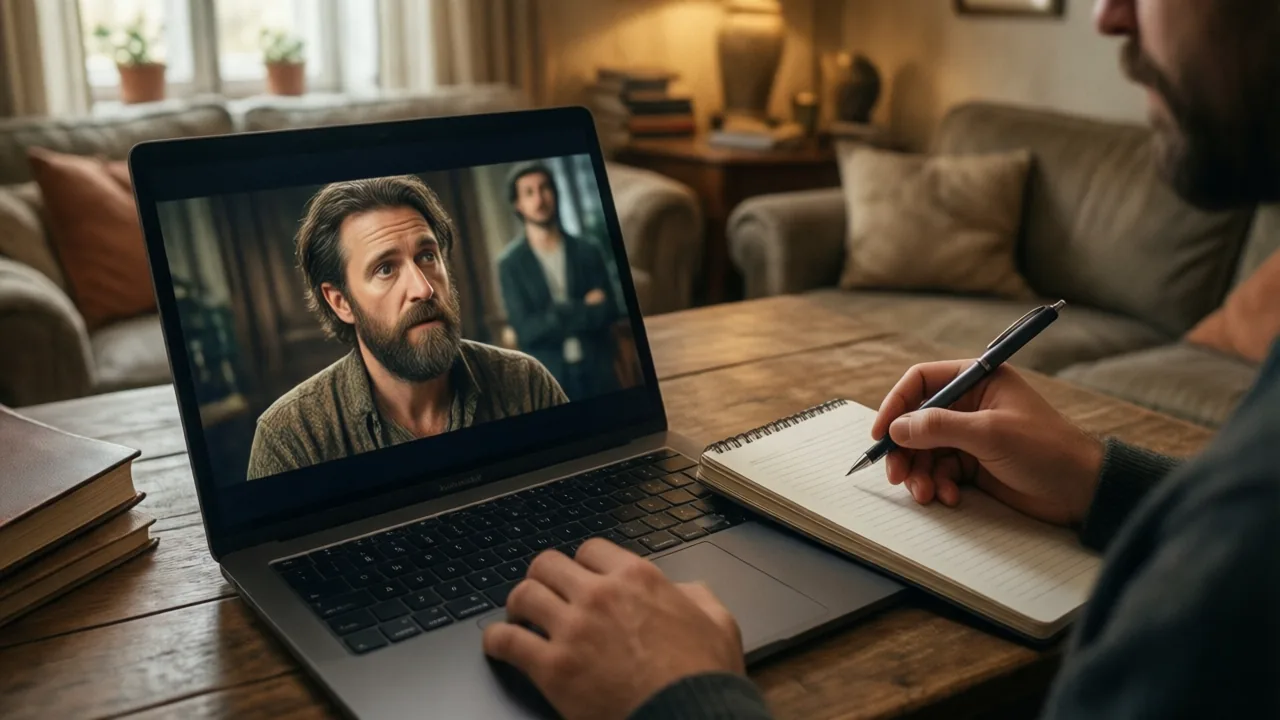
Ciao! I’m Giulia. My 10 unmissable Italian TV shows is the most-read post on this blog, and my inbox fills with the same question every week: “Giulia, I’ve binged three Italian series on Netflix and I still understand nothing. Is watching TV a waste of time?”
It isn’t — but binge-watching in the wrong order is. Here is the method my students use, the one that turns your evening on the sofa into real listening practice.
The short answer
You can learn Italian by watching TV — comprehension, rhythm and real spoken Italian. You can’t learn it that way alone. The method: right level, English subs for 2–3 episodes, then Italian subtitles, repeat one scene per episode, note 5 phrases, and finish one series before starting another.
What TV teaches you — and what it never will
TV is genuinely good at three things:
- Listening. Real speed, real mumbled Italian — nothing like textbook audio.
- Rhythm and pronunciation. You absorb the melody of the language, gestures included.
- Everyday phrases. Ma dai!, Allora, Mi sa di no — the stuff courses skip.
What it will never do: explain the passato prossimo, correct your speaking, or build vocabulary from zero. So treat TV as one training tool, alongside a course or tutor — not as the whole program.
Step 1: Pick the right level (this is 80% of it)
Gomorrah broke thousands of beginners. Start where your ear actually is:
| Your level | Watch this | Where |
|---|---|---|
| A1 | Extra (Extra! Extra!) — built for learners | YouTube |
| A1–A2 | Camera Café — 10-minute office sketches | Netflix / RaiPlay |
| A2 | Un Medico in Famiglia, Che Dio Ci Aiuti | RaiPlay / Netflix |
| B1 | Don Matteo, L’Amica Geniale | RaiPlay / HBO |
| B2+ | Gomorrah, Suburra, Montalbano | Netflix |
Full ratings and reasons: 10 unmissable Italian TV shows.
Step 2: Subtitles — the honest order
- Episodes 1–3: English subtitles are allowed, to lock the plot in.
- Then switch to Italian subtitles (sottotitoli in italiano). This is the step that works: your eyes link the sound you missed to the word you can already read.
- Later, try one scene with no subtitles — you’ll be surprised how much stuck.
Watching with English subtitles for months feels like studying and teaches your ear almost nothing. This is the #1 reason people binge five series and stay at zero.
Step 3: One scene, five minutes, ten times
Pick one 2–3 minute scene per episode. Watch it normally. Then play it again pausing every line and repeating out loud what you hear — ugly, exaggerated, out loud. Five minutes of this scene-repetition trains your mouth and ear more than two hours of passive viewing.
Step 4: The 5-phrase notebook
Write down only five phrases per episode — complete phrases, not single words: “Che ne dici di…?”, “Non ci penso nemmeno”, “Mi sa che piove”. Review them the next morning. Five phrases × ten episodes = 50 phrases of living Italian, which is worth more than any app streak.
Step 5: Finish one series
The magic is repetition: the same voices, the same kitchen, the same complaints about the trains. Commit to one series for at least 5–10 episodes before touching another. Your comprehension of episode 10 will shock you compared to episode 1.
Where to watch in 2026
- Netflix — most reliable Italian audio + Italian subtitle pairs. Settings: Audio: Italiano, Subtitles: Italiano (CC).
- RaiPlay — free, 100% authentic, no English subs; best from solid A2 upward. Needs an Italian IP outside Italy.
- YouTube — Extra (Extra! Extra!), free, made exactly for A1.
The 4 mistakes I see every month
- Starting with crime dramas. Crime dramas are C1. Start with a sitcom.
- English subtitles forever. Your ears never get the input.
- Jumping between five series. Repetition is the teacher — repetition across one series.
- Watching without speaking. Shadow the lines out loud, even badly.
TV sharpens an ear you have already trained. To train it properly first, the free crash course covers the A1 basics in ten lessons — and with personal tutoring you turn every phrase you heard into a phrase you can say.
Then go watch Don Matteo. Buona visione — e ripetete ad alta voce!